Reference
Circuits 13 circuits in 10 countries, and one oval he never raced on
The 13 circuits where Juan Manuel Fangio started World Championship races, and Indianapolis: his record at each, what each was like then and what is left now.

Circuits
Nearly 21 years after his last race, Fangio named the tracks he had liked best, and said what had become of them:
…In the time I raced my favourite tracks were the Nurburgring, Spa, Berne and Monza. Of these, only Monza survives for grand prix cars - and maybe not for much longer. But the world changes, no?
In 1979 he was right. Switzerland had banned circuit racing after Le Mans in 1955, so Bremgarten had seen its last Grand Prix in 1954; Spa’s 14 kilometres of public road had last been used by Formula 1 in 1970; and the Nürburgring’s Nordschleife held its last Grand Prix in 1976. Monza held on, and holds on still. Spa has a Grand Prix again, on a circuit half the length of his, and the Nordschleife is still raced on, though not by Formula 1.
In the World Championship he started races on 13 circuits in 10 countries, and won on 11 of them. Only Aintree and Pescara escaped him, and at each he was second once. He raced most at Monza, seven times; he won most at Buenos Aires, four times in a row; and at Monaco he started from pole on each of his four visits. Six of the 13, Reims-Gueux among them, no longer hold races of that kind. A fourteenth circuit, the Indianapolis Motor Speedway, is here too, though he never started a race there.
Circuits
Starts, wins and poles
The World Championship races he started, counted circuit by circuit in the order he first raced at each. A shared drive counts once, and each name leads to its entry below.
| Circuit | Starts | Wins | Poles |
|---|---|---|---|
| SilverstoneBritain · 1950–1951, 1953–1954, 1956 | 5 | 1 | 1 |
| MonacoMonaco · 1950, 1955–1957 | 4 | 2 | 4 |
| Bremgarten, BernSwitzerland · 1950–1951, 1953–1954 | 4 | 2 | 3 |
| Spa-FrancorchampsBelgium · 1950–1951, 1953–1956 | 6 | 3 | 4 |
| Reims-GueuxFrance · 1950–1951, 1953–1954, 1956, 1958 | 6 | 3 | 4 |
| MonzaItaly · 1950–1951, 1953–1957 | 7 | 3 | 5 |
| NürburgringGermany · 1951, 1953–1954, 1956–1957 | 5 | 3 | 3 |
| Pedralbes, BarcelonaSpain · 1951, 1954 | 2 | 1 | 0 |
| Buenos Aires AutodromeArgentina · 1953–1958 | 6 | 4 | 2 |
| ZandvoortNetherlands · 1953, 1955 | 2 | 1 | 1 |
| AintreeBritain · 1955, 1957 | 2 | 0 | 0 |
| Rouen-les-EssartsFrance · 1957 | 1 | 1 | 1 |
| PescaraItaly · 1957 | 1 | 0 | 1 |
Azure rule: he won there.
Circuits
The six circuits of 1950
Silverstone
A Royal Air Force airfield in the war, Silverstone was the home of the British Grand Prix less than three years after it, and on 13 May 1950 it held the first World Championship race of all. It was his debut: four Alfa Romeo 158s filled the front row, and he was out after 62 laps of 70. He came back four times. In 1951 he was second to José Froilán González, whose Ferrari won the Scuderia’s first championship race; in 1953 he was second to Alberto Ascari; in 1954, in the rain, he kept hitting the oil drums that marked the course in the streamlined Mercedes-Benz W196 and was fourth. In 1956, after Stirling Moss’s Maserati faltered, he won: his only win in Britain. The lap was 4.649 km in 1950 and 1951 and 4.711 km from 1953; today’s circuit, of 5.891 km, still holds the British Grand Prix.
Monaco
The round-the-houses circuit of 1929, 3.18 km in 1950 and 3.145 km from 1955, is the only one where he started from pole and set the fastest lap every time he raced, four times; he won twice. In 1950, his first championship win, he came round on the second lap to find the road at Tabac blocked by the first lap’s pile-up and, by his own account, stopped short of the wreckage; others spoke of a sixth sense, and he put it down to luck. In 1955 his transmission failed while he led. In 1956 he spun at Ste Dévote, bent a wheel against the wall, handed his car to Eugenio Castellotti and finished second in Peter Collins’s. In 1957 Moss crashed at the chicane on lap 4, Collins and Mike Hawthorn went out with him, and Fangio came through untouched to win. The circuit is 3.337 km now, with a swimming-pool section on reclaimed land and a hotel over the tunnel.
Bremgarten, Bern
A forest circuit of 7.28 km outside Bern, all quick corners and hardly a straight, with trees overhanging the road that made it treacherous in the wet; Achille Varzi had been killed there in 1948. Fangio started 4 races there, took 3 poles and won twice: in the wet in 1951, and in 1954 by 57.8 seconds from González, in the open-wheeled W196, a win that settled his second title. It was the last Swiss Grand Prix. Because Switzerland banned racing after Le Mans the next year, the fastest laps of the championship era at Bremgarten, by ChicaneF1’s record, are still his: 2:35.9 in practice in 1951 and 2:39.7 in the race of 1954.
Spa-Francorchamps
In his day Spa was 14.12 km of public roads: La Source, Malmedy, the Masta straight and its kink, the Stavelot hairpin. He started 6 races there, took 4 poles and won 3, in 1950, 1954 and 1955. The defeats were stranger than the wins. In 1951 a wheel jammed on its hub at his stop, and he finished ninth; in 1953, in Johnny Claes’s car after his own engine had failed, the steering broke on the last lap and he crashed. In 1949, before the championship, a piston had failed while he led. Formula 1 left the old circuit after 1970; today’s is 7.004 km.
Reims-Gueux
A fast triangle of public roads west of Reims, where races were often settled in the slipstream and the organisers felled trees and pulled down houses to ease the corners; the lap was 7.815 km in 1950 and 1951, 8.347 km in 1953 and 8.302 km from 1954. It saw his first races in Europe, for Gordini, on 18 July 1948, as To Europe tells. In the championship he started 6 races there, took 4 poles and won 3 times: in 1950, in 1951 with the car Luigi Fagioli had started in, and in 1954, the W196’s first race, by a tenth of a second from Karl Kling. In 1953 Hawthorn beat him by one second after a duel of some 30 laps. His last race was here, on 6 July 1958: he was fourth. The circuit closed in the early 1970s, but its pits and grandstands still stand on the road from Thillois to Gueux, the sponsors’ names fading on them.
Monza
The circuit in the royal park, opened on 28 August 1922, is the one he raced at most: 7 starts, 5 poles, 3 wins, on three layouts, the 6.3 km road circuit until 1954, the 10 km road-and-banking course in 1955 and 1956, and the 5.75 km road circuit in 1957. Two failures there cost him the 1950 title. On 8 June 1952, in a race outside the championship, he crashed on the second lap and broke his neck, as 1952 tells. In 1953 he won at the last corner, his one championship win of the year; in 1955 he won Mercedes-Benz’s last Grand Prix before the team withdrew; and in 1956 he finished second in Collins’s car on the day he became champion for the fourth time. He had won the Formula 2 Gran Premio dell’Autodromo there in June 1949, in a Ferrari 166 F2 of the Automóvil Club Argentino, and in 1958 he raced an American car there in the Race of Two Worlds. Monza is 5.793 km now, with chicanes, and the banking is long out of use.
Circuits
Seven more, 1951–1957
Nürburgring
The Nordschleife, opened on 18 June 1927, ran for 22.81 km through the Eifel, bordered in his day by high hedges. He started 5 races there and never finished lower than second: second in 1951 and 1953, then the winner 3 times. In 1954 his first German Grand Prix win came the day after his former Maserati team-mate Onofre Marimón was killed in practice. In 1956 he took pole, set the fastest lap, led every lap and won. In 1957 came the 52-second pit stop, the chase of the two Ferraris and the lap of 9:17.4, which The Nürburgring, 4 August 1957 tells lap by lap. After that third win he was named Ring-Meister and given a diamond star. No Grand Prix has been held on the Nordschleife since 1976; the old circuit is used for the 24-hour race and the NLS series, and a modern Grand Prix circuit has been built at the old start.

Pedralbes, Barcelona
An unusually fast street circuit of 6.316 km, on wide avenues in the western suburbs of Barcelona. He raced there twice and won once: on 28 October 1951, in the last race of the season, Ferrari’s tyres threw their treads, he won by 54 seconds and was World Champion for the first time. In 1954, with oil spraying into the cockpit, he was third. It was one of only two of his championship circuits, with Aintree, where he never took pole. The circuit closed after 1955, and its avenues are city streets again.
Buenos Aires Autodrome
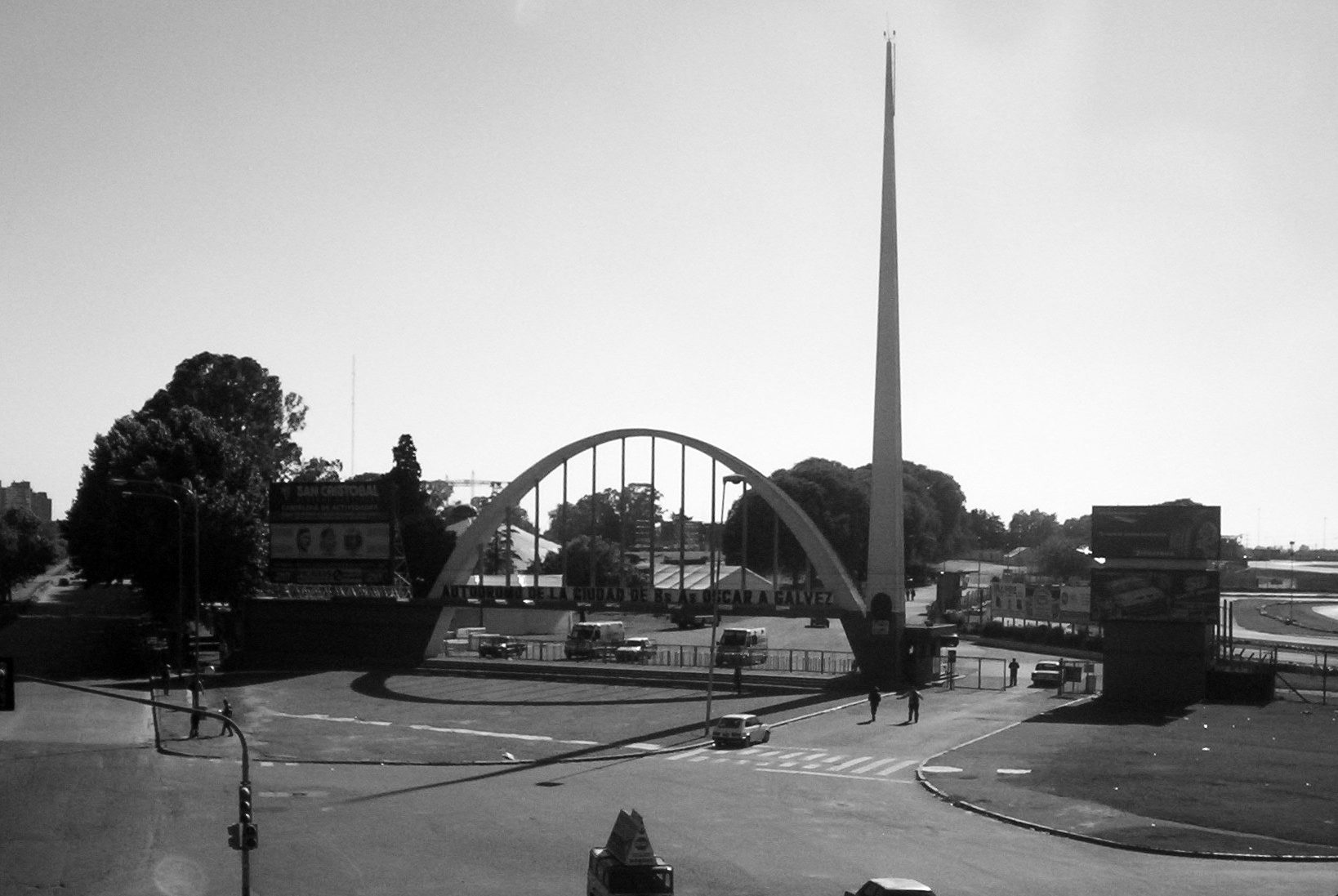
It opened on 9 March 1952, within the city limits, as the Autódromo 17 de Octubre, the date of Perón’s rise to power, with a dozen possible layouts; the Grand Prix lap he knew was 3.912 km. He won the Premio Presidente Perón on the opening day, and at the opening, by a report published in 2017, he said: “It is the best autodrome built to date, very safe and attractive to race on. And ten different circuits can be used” (attributed). The first championship Argentine Grand Prix, on 18 January 1953, was the first in South America, and it was marred when Nino Farina’s car struck the crowd; how many spectators died is not settled. Fangio won the next four, from 1954 to 1957, the one of 1956 in Luigi Musso’s car, and the race of 1955, with the air at 35°C and the track at 52°C, was by his own account his hardest. He also won the Formula Libre Buenos Aires Grand Prix there in 1955, 1957 and 1958, the last his last victory of all. After Perón’s fall the circuit was renamed; it now carries the names of the brothers Oscar and Juan Gálvez, and it held 20 championship Grands Prix between 1953 and 1998.
Zandvoort
Built after the war on roads the German army had left behind the coast, among dunes that served as grandstands; its lap was 4.193 km. He raced there twice. In 1953 his rear axle broke on a freshly laid surface that was already coming apart. In 1955, a week after Le Mans, he started from pole and led from start to finish, with Moss 0.3 seconds behind at the flag. The circuit was shortened in 1989, lengthened in 1999 and banked for the Dutch Grand Prix’s return in 2021; the race of 23 August 2026 was, by Motor Sport’s account, the last Dutch Grand Prix for the foreseeable future.
Aintree
A flat circuit of 4.828 km laid out round the Grand National racecourse, with room for up to 140,000 spectators. He raced there twice, took no pole and won nothing, yet one of his titles was settled there. On 16 July 1955 he finished second to Moss, 0.2 seconds behind, the closest defeat of his championship career, and the result made him champion for the third time; whether he let Moss win has been argued ever since, and Fangio and Moss weighs the evidence. In 1957 he started fourth and retired after 49 laps. The Grand Prix circuit closed in 1964; the club circuit ran until 1982 and has since reopened for sprints and track days.
Rouen-les-Essarts
Woodland south of Rouen, and a steep descent to the cobbled Nouveau Monde hairpin; 6.542 km. He raced there once, in the French Grand Prix of 7 July 1957, took pole and won, in a Maserati 250F, passing Jean Behra and Musso in the first 4 laps. The circuit closed in 1993.
Pescara
Everyday roads by the Adriatic and inland through villages and over level crossings: about 25.6 km, the longest circuit ever to hold a World Championship race. The championship came there once, on 18 August 1957, after other races had been cancelled. He took pole in 9:44.6, slid on Musso’s oil into a kerb, stopped for a new wheel and finished second to Moss, whose fastest lap was also 9:44.6. Motor Sport’s report listed the hazards, kerbstones, bridges and hairpins among them, and concluded that “the whole thing is pure unadulterated ROAD RACING.” He had won there before, in the non-championship Pescara Grand Prix of 1950, for Alfa Romeo. The roads last saw racing in 1961.
Circuits
The oval he never raced on
Indianapolis Motor Speedway
The 4.023 km (2.5-mile) oval whose 500-mile race counted towards the World Championship from 1950 to 1960. In May 1958 he came to drive the Dayton Steel Foundry Special, a Kurtis Kraft. On 8 May he passed the rookie test, and a week later, on 15 May, he withdrew before qualifying; 1958 tells why. It is the only championship circuit in his career that never saw him start, which is why the table above leaves it out. The Indianapolis 500 is still run there.
Five of the circuits on this page held a Grand Prix in 2026, and the Speedway still runs its 500. Of the others, the Nordschleife, the Buenos Aires autodrome and Aintree’s club circuit are still in use; the rest have closed or gone back to being roads.
Sources
F1DB, release v2026.15.1, the open Formula One database, for his record at each circuit and each layout’s length and history; the Jolpica F1 database, dump of 15 September 2026, for the same record, computed separately. github.com; api.jolpi.ca
ChicaneF1, Juan Manuel Fangio and its circuit pages, for lap lengths, poles, fastest laps and the Bremgarten records. chicanef1.com
Motor Sport database, the circuit pages for Silverstone, Monaco, Bremgarten, Spa-Francorchamps, Reims, Monza, the Nürburgring, Pedralbes, Buenos Aires, Zandvoort, Aintree, Rouen-les-Essarts and Pescara, and the 1957 Pescara Grand Prix. motorsportmagazine.com
Nigel Roebuck, interview with Fangio in London, Autosport, 21 June 1979, republished as “Fangio: interview with a legend”, 2011; and “The morning I met the maestro”, Motor Sport, November 2010. autosport.com; motorsportmagazine.com
Paul Fearnley, “Ring leader”, Motor Sport, December 2002; “Fangio the supreme master”, Motor Sport, September 1957; “Don’t fry for me”, Motor Sport, January 1999. motorsportmagazine.com
Gobierno de la Ciudad de Buenos Aires, “Autódromo Oscar y Juan Gálvez”; “El autódromo Oscar y Juan Gálvez cumple 65 años”, La Nación, 2017; grandprix.com, Argentine Grand Prix 1953. buenosaires.gob.ar; lanacion.com.ar; grandprix.com
Museo Juan Manuel Fangio, car page “Maserati 250 F – 1957”, and “Las 200 carreras de Juan Manuel Fangio”, for the races outside the championship. museofangio.com
Indianapolis Motor Speedway, “F1 rookies at IMS, part 1”, 10 April 2012. indianapolismotorspeedway.com