
The seasons
1956
One season with Scuderia Ferrari, and the fourth title
Cover: Zairon · CC BY-SA 4.0
1956
The season in figures
- Grands Prix started
- 7
- Grand Prix wins
- 3
- Pole positions
- 6
- Podiums
- 5
- Team
- Scuderia Ferrari
- Car
- Lancia-Ferrari D50 (2.5-litre V8)
- Tyres
- Englebert
- Numbers
- 30 and 34 (Musso’s), 20 and 26 (Collins’s), 2, 10, 1, 1, 22 and 26 (Collins’s)
- Team-mates
- Peter Collins, Eugenio Castellotti, Luigi Musso, Alfonso de Portago; Olivier Gendebien (Argentina, France); Paul Frère and André Pilette (Belgium); Wolfgang von Trips (Italy, did not start)
- Points
- 33 (30 counted)
- Finished
- World Champion
1956
A year he had not meant to race
The freeze of his property at home, with which 1955 ends, was still in force early in 1956, when he said that his main goal was to win the World Championship for a fourth time.
It would take years to settle in his favour. Enzo Ferrari had already telephoned him at Pescara, and Fangio remembered the words well: “Fangio, I know you cost a lot but I need you.” (attributed)
He was not very happy about joining Ferrari, he admitted later. His terms were negotiated by a new manager, Marcello Giambertone. Ferrari’s secretary, Romolo Tavoni, told Chris Nixon that Ferrari usually split the prize money with his drivers half and half, and that he resented it when Fangio asked for a salary as well; Brock Yates put the deal at about 12 million lire a year, with extras. Karl Ludvigsen’s verdict is that the relationship began sourly and never improved. At Maserati, Ermanno Cozza and Giulio Alfieri suggested that he had chosen Ferrari for the Lancia cars and for the money, and a dispute over the gold trophy from the 1955 Venezuelan Grand Prix had already cooled his relations with them.
The car was not quite a Ferrari. Vittorio Jano had designed the D50 for Lancia around a 2.5-litre V8 that carried the chassis loads, with the fuel in pannier tanks slung between the wheels. On 26 July 1955 Lancia handed six of its eight D50s to Ferrari at Turin, with the spares, the drawings and the tools, and Jano followed the cars to Maranello. For 1956 Ferrari moved the fuel into the tail and into small tanks beside the cockpit, faired the empty pontoons into a full-width body and put its own badge on the cars: the Lancia-Ferrari D50, on Englebert tyres. None of the original cars survives; the one on this page’s cover, assembled from parts and kept in Turin, stands for the type, in No. 1, the number he carried to his British and German Grand Prix wins. Fangio was not named the team’s leader. Ferrari dealt with him through intermediaries and by telegram, and it was a telegram in mid-season, the team manager Eraldo Sculati said later, that made him captain of the team.
1956
Two borrowed cars
Only Ferrari and Maserati came to the Argentine Grand Prix at the Buenos Aires Autodrome on 22 January, and Ferrari brought a mixed collection of Lancia and Ferrari parts. Fangio took pole by 2.2 seconds, 1:42.5 to Eugenio Castellotti’s 1:44.7: a second faster, Ludvigsen noted, than his Mercedes-Benz had gone the year before. The fuel pump of his own car, No. 30, failed after 22 laps, and Luigi Musso was called in to hand over No. 34. The lead changed hands between Musso, González, Carlos Menditeguy, Stirling Moss and Fangio himself; in Musso’s car he closed on Moss’s oil-trailing Maserati, went ahead at about two-thirds distance and spun off twice on the way to winning by 24.4 seconds from Jean Behra, with Mike Hawthorn third. Motor Sport reported what he said afterwards: “He admitted freely that he had not had to drive a Grand Prix car so near the limit for a very long time.” Maserati protested that he had been push-started; the protest was rejected. The win, and its points, were shared with Musso.
Before Monaco he also won the Buenos Aires Grand Prix, run that year at Mendoza, the Sebring 12 Hours with Castellotti in a Ferrari 860 Monza and the Syracuse Grand Prix from pole, with a new lap record of 1:59.9 and Ferraris in the first three places. He was fourth in the Mille Miglia in a Ferrari 290 MM with rainwater swilling round his cockpit, and in the International Trophy at Silverstone in May the clutch failed on his car and then on Peter Collins’s, which he had taken over.
At Monaco there was a £100 prize for the fastest lap in Thursday’s practice. With 15 minutes left he went out on an empty track and lapped in 1:44.2; Collins took the same car out afterwards and could not approach his time. On the Saturday morning he did 1:44.0 for pole.
Moss led away in his Maserati. On lap 2, going under the footbridge into Ste Dévote, Fangio spun; Musso ran into the straw bales avoiding him and Harry Schell hit a wall. Fangio fought his way back past Castellotti, Behra and Collins, crumpling the nose of his car, then struck the wall on the right before the pits and bent a rear wheel. At 40 laps, with the clutch slipping, he came in, and his car went to Castellotti, who finished fourth in it. At 54 laps Collins, running second, was called in to give up his. The museum says Ferrari ordered it; Autosport reported that Collins was so vexed he went straight to his hotel. By Motor Sport’s count Fangio had three accidents in his own car and none in Collins’s. He set off after Moss, who was about 50 seconds ahead, and took the fastest lap of the race on the 100th and last lap.
- Moss’s lead when he took Collins’s car, seconds
- 50
- At the flag
- 6.1
Autosport put it bluntly: “Fangio was a crazy mixed-up racing driver that day.” (attributed) Fangio answered the charge 23 years later, in London: “It was maybe the strongest race I ever drove.” Those who doubted him, he said, did not know what had been happening in the car. He had hit oil when he crashed his own, and what followed, however it looked from outside, was the quickest way round that circuit in that car.
1956
A mechanic of his own
In practice at Spa-Francorchamps Moss did 4:14.7, and Fangio looked up from the pit counter where he had been sitting. He went out and did 4:10.4, then 4:09.8: pole by 4.9 seconds, and 10.8 seconds inside the previous year’s record. The race on 3 June started in rain. He was slow away, fifth by Eau Rouge, past Castellotti on lap 3 and in the lead on lap 5. He was 30 seconds ahead of Collins when, on lap 24, he coasted to a stop just beyond the Stavelot bend with his transmission broken; the museum and Paul Fearnley say the differential had run short of oil. Each time Collins came past he waved, and Collins won his first Grand Prix.
Enzo Ferrari’s son Dino died on 30 June, the day before the French Grand Prix at Reims-Gueux. There Fangio took pole with 2:23.3, and Motor Sport reported that “he quietly explained that the gear-lever was jumping out of fifth and halfway round the curve he had to let go of the steering wheel with his right hand and hold the lever in gear! World Champion?”
In the race the three Lancia-Ferraris of Fangio, Castellotti and Collins ran side by side along the straights to keep Schell’s faster Vanwall behind them. Fangio drove Schell off with a lap of 2:25.9 on lap 33. On lap 41, after his pit had signalled him to slow, a fuel line split; the stop to mend it dropped him to fourth, and his last lap, 2:25.8, was a new record. He finished 5 seconds behind Behra. Collins won, 0.3 seconds ahead of Castellotti, under orders to hold their places.
The driver must always have a relationship with his mechanic … It was this that I found hard to achieve in the Ferrari team. I had been their opposition for so many years and now I was their driver.
Three times his own car had failed him: a fuel pump, a transmission, a fuel line. After Reims, the museum says, he decided to leave the team. At Mercedes-Benz he had had a mechanic who worked on his car alone; at Ferrari the mechanics worked on every car, and he blamed the small failures on that. He stayed only when Ferrari agreed to give him a mechanic of his own, named by Ludvigsen as Cassani, after a meeting with Giambertone. Fearnley adds that Fangio took a rest at the time on a specialist’s advice.
Giambertone would later write that Ferrari wanted Collins to win and would even speak of a boycott. The failures are on the record; any intent behind them is not. Fangio himself told the museum: “…I don’t believe things happened on purpose. That wouldn’t make sense. When I had differential trouble in Belgium from lack of oil, Castellotti had it too…” (attributed)
1956
Silverstone and the Nürburgring
The British Grand Prix at Silverstone on 14 July came to him by good fortune. He started from second on the grid, chased Hawthorn’s BRM and spun at Becketts on lap 8, lying second. Moss’s Maserati led until it lost power on lap 69 and then broke its gearbox; Fangio went ahead and won by a lap, with a misfire in the corners and about 20 litres of fuel left. Motor Sport’s reporter watched him passing on both sides and going into corners on the overrun, far too fast for neatness. It was the only British Grand Prix he ever won.
At the Nürburgring on 5 August Collins led away from the start, but Fangio was in front by the end of the first lap and stayed there for all 22: pole, the win, the fastest lap and every lap led, a grand slam he had last managed at Monaco in 1950. His best lap, 9:41.6 on lap 14, was a new record, and he won by 46.4 seconds from Moss, who nursed a failing transmission home in second place. Of the five Lancia-Ferraris only his finished. Collins, dazed by fumes from a split fuel pipe, took over Alfonso de Portago’s car and later spun it off into the trees, unhurt. Motor Sport remarked that Fangio was of an age to be father to Moss and Collins alike. With one round left he had 30 points counted to the 22 of Collins and of Behra.
A week later he drove the Swedish Grand Prix for sports cars at Kristianstad, sharing a Ferrari with Castellotti. It retired.

1956
Monza, 2 September
The Spanish Grand Prix was cancelled, so the Italian Grand Prix at Monza, run over the road circuit and the banked track together, was the last round. Only a win with the fastest lap, worth 9 points, could lift Collins or Behra past Fangio, and Moss, on 19, could not catch him at all. Before the race, Sports Illustrated wrote of Collins: “Then an Italian mechanic pointed a finger at him and said, ‘Campione del mondo [world champion].’ Collins smiled, shook his head and nodded genially toward Fangio.”
- His counted points before Monza
- 30
- Collins’s and Behra’s
- 22
Fangio took pole with 2:42.6, the fastest time yet seen there. The race was hard on the Lancia-Ferraris’ Englebert tyres, which began to throw their treads on the banking; Castellotti and Musso, racing each other, were in for new ones on lap 5. Fangio, Moss, Schell’s Vanwall and Collins slipstreamed for the lead until lap 19, when Fangio came slowly into the pits with his front wheels pointing different ways: the right-hand steering arm had broken. His car was mended with the steering arm from de Portago’s crashed car and given to Castellotti.
On lap 30 Musso came in to have his tyres checked, and Fangio stood ready to take over. Musso stayed in the car: in Fangio’s memory the team manager asked him to give it up and he refused, while Motor Sport wrote at the time that Musso was fit and carried on.1 On lap 35 Collins stopped to change a front tyre, climbed out and waved Fangio into his car.2 Whether he did it of his own accord is disputed. Fangio always said it was spontaneous, done in front of Sculati; Sports Illustrated’s report that week has the Ferrari pit showing Collins its flag and Collins pulling in obediently; Luca Dal Monte, quoted by Ludvigsen, writes that Enzo Ferrari had spoken to Collins before the race, in vague but suggestive terms.
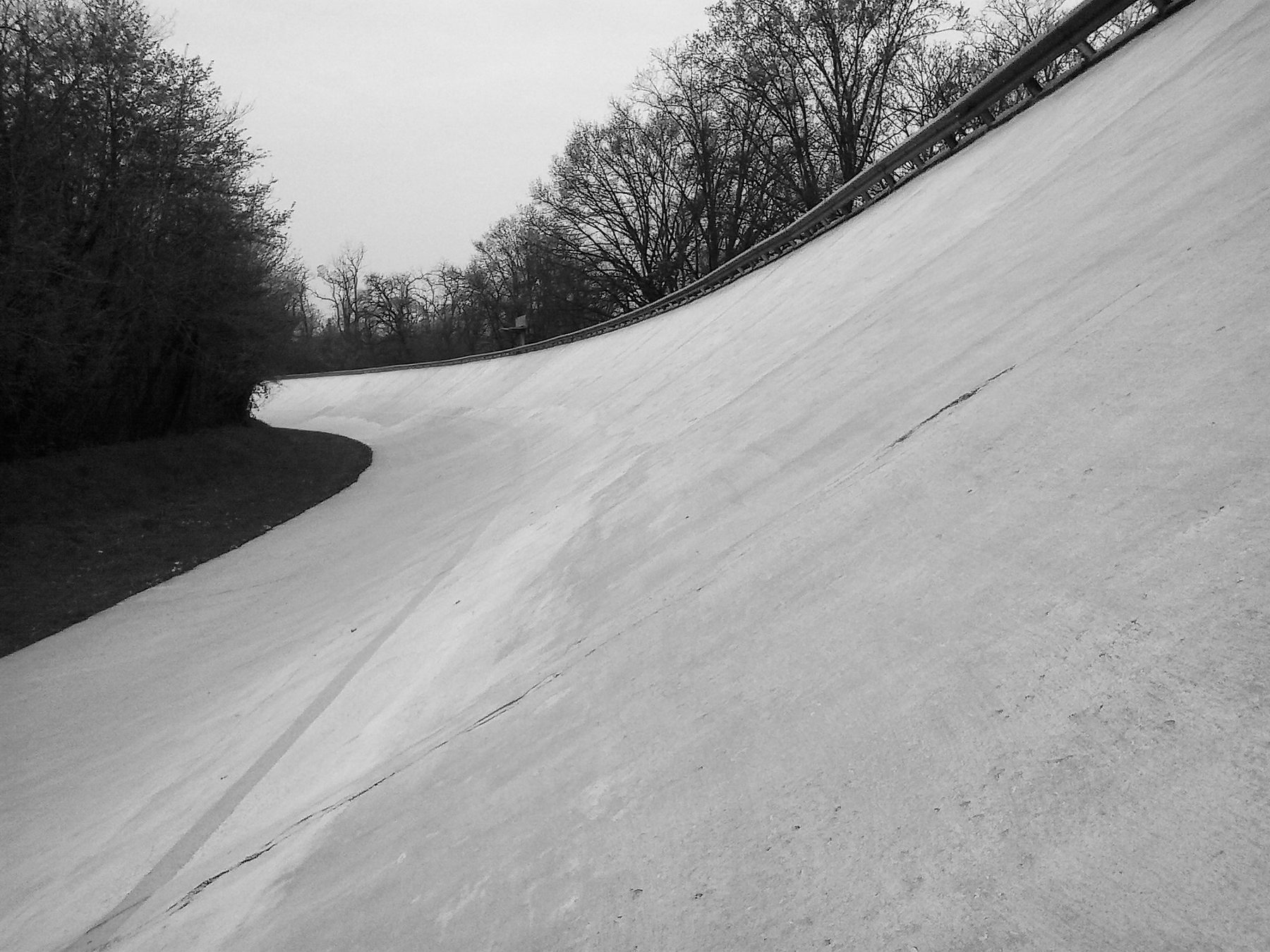
The race had one more turn in it. Moss ran out of fuel on lap 45 and was pushed to his pit by Luigi Piotti’s Maserati; Musso took the lead, and 3 laps from the end his own left-hand steering arm broke as he came off the south banking. He stopped within inches of the pit counters. Moss won by 5.7 seconds from Fangio in Collins’s car. Wolfgang von Trips’s crash in practice, it was found afterwards, had been caused by a broken steering arm too.
The title was Fangio’s, by 30 points to Moss’s 27 and Collins’s 25.3 His half share of second place, 3 points, counted for nothing under the rule that kept each driver’s best five results. What Collins gave up on lap 35 was his own slim chance: he was running third, behind Moss and Musso, and needed both the win and the fastest lap. Enzo Ferrari’s later claim that Collins would otherwise have been champion with mathematical certainty is not borne out by the points. None of that diminished the gesture in Fangio’s eyes. In London in 1979 he still remembered it with emotion:
He had still the chance to be world champion, but he jumped out of his car and offered it to me. I was moved almost to tears by the gesture.
Denis Jenkinson’s verdict in Motor Sport was that “the results have put the three main contestants, Fangio, Moss and Collins, in their right order of ability in the eyes of many people”.
1956
After Monza
He raced a Ferrari once more, finishing second in the Venezuelan Grand Prix for sports cars at Caracas in November, and then left. For 1957 he signed for Maserati. Ferrari’s comment, in Ludvigsen’s English, was “we won’t have the World Champion. We won’t have him because we don’t have enough money.” (attributed)
The quarrel outlived the season, and Giambertone’s book sharpened it when it appeared. Fangio said he had not written the book and had received nothing for it, and he thought Ferrari’s displeasure was logical. About 10 years later Ferrari asked him to lunch at Maranello. By the museum’s account they talked about everything except those awkward matters.
Of the team-mates he had shared his cars with that year, Castellotti was killed testing at Modena in March 1957; Musso and Collins died in 1958, a month apart. Asked about the Ferrari year in 1979, Fangio began: “Well, I must say the year with Ferrari was not happy.”
1956
Race by race
| Rd | Grand Prix | Grid | Res. | Pts |
|---|---|---|---|---|
| 1 | ArgentineIn Musso’s car, No. 34 | 1 | 1 FL | 5 |
| His own car, No. 30: retired after 22 laps (fuel pump). Musso’s No. 34: 1st. 5 points: half of 8, plus 1 for the fastest lap. Musso was called in to give up his car; Fangio spun late on; Maserati protested a push-start, dismissed on appeal. | ||||
| 2 | MonacoIn Collins’s car, No. 26 | 1 | 2 FL | 4 |
| His own car, No. 20, handed to Castellotti on lap 40: 4th. Collins’s No. 26, from lap 54: 2nd. 4 points: half of 6, plus 1 for the fastest lap. Spun at Ste Dévote early, causing Musso and Schell to crash, bent a wheel on a wall; in Collins’s car closed on Moss at about two seconds a lap. | ||||
| 4 | Belgian | 1 | Ret | 0 |
| Transmission. Poor start in the wet; led from lap 5 until the failure; Collins won. | ||||
| 5 | French | 1 | 4 FL | 4 |
| A leaking fuel pipe forced a stop; he chased Behra to the finish. | ||||
| 6 | British | 2 | 1 | 8 |
| Spun early; led after Moss’s Maserati faltered. | ||||
| 7 | German | 1 | 1 FL | 9 |
| Led from lap one, setting new lap records; Moss second; “grand slam”. | ||||
| 8 | ItalianIn Collins’s car, No. 26 | 1 | 2 | 3 |
| His own car, No. 22, handed to Castellotti: 8th. Collins’s No. 26, from lap 35: 2nd. 3 points: half of 6. A steering arm broke on his own car (lap 19); Musso would not give up his; Collins, who could in theory still have won the title (only by winning with fastest lap), handed his car over when he stopped to change a front tyre; Moss won; the 3 points for second were not counted, but with Collins’s chance gone the title was Fangio’s. | ||||
| Season | 33 | |||
Azure rule: a win. Bold grid figure: pole position. Broken rule and half-disc: a shared drive, the car changing hands and the points divided. FL: fastest lap. Points: 33 scored, 30 counted.
1956
Key dates
Wins the Argentine Grand Prix in Luigi Musso’s Lancia-Ferrari.
Buenos Aires 1000 km with Castellotti: retires.
Wins the Buenos Aires Grand Prix, held at Mendoza, Lancia-Ferrari D50.
Wins the Sebring 12 Hours with Castellotti, Ferrari 860 Monza.
Wins the Syracuse Grand Prix.
Mille Miglia, fourth, Ferrari 290 MM.
Monaco Grand Prix: second in Peter Collins’s car.
Nürburgring 1000 km, second with Castellotti.
Wins the British Grand Prix.
Wins the German Grand Prix.
Italian Grand Prix: after his own car’s steering arm breaks, Collins hands over his car on lap 35; second place. The title is his (fourth), secured when Collins’s own slim chance ended; the 3 points for the shared second place were not counted under the best-five rule.
Notes
Fangio’s account is his interview with Nigel Roebuck in 1979; Karl Ludvigsen writes that Musso ignored the team manager’s pleas. Jenkinson’s report in Motor Sport, October 1956, says only that Fangio stood by in case Musso was tired. ↑
Lap 35 in Motor Sport’s report of October 1956, which says Collins came in to change his left front tyre; lap 34 in Ludvigsen; lap 36 in Sports Illustrated. ↑
The points are the official record’s: 33 scored, 30 counted. Ergast and Jolpica give 34½ scored, because they also credit him with a share of the fourth place of his own car at Monaco, which Castellotti drove home. ↑
Sources
F1DB, release v2026.15.1: results, grids, laps, fastest laps and points. github.com
grandprix.com race reports, 1956: Argentine, Monaco, Belgian, French, British, German and Italian Grands Prix. grandprix.com
Motor Sport, 1956: “The Argentine season” (March); “The VI Gran Premio di Siracusa” (May); “Vanwall victory in Daily Express International Trophy” and “XIV Grand Prix de Monaco” (June); “Grand Prix de Belgique” (July); “The 42nd Grand Prix” and “The British Grand Prix” (August); “XVIII Grosser Preis von Deutschland” (September); “Gran Premio d’Europa” and D. S. Jenkinson, “Continental Notes” (October). motorsportmagazine.com
Karl Ludvigsen, “In the Camp of the Enemy”, Forza, no. 169: the contract, the asset freeze, and the words of Fangio, Ferrari, Tavoni, Hawthorn, Autosport and Dal Monte. forza-mag.com
Paul Fearnley, “The noble Peter Collins”, Motor Sport, 25 August 2016. motorsportmagazine.com
Doug Nye, “The grand prix great that doomed a team”, Motor Sport, July 2020: the D50 and its handover to Ferrari. motorsportmagazine.com
Mattijs Diepraam, “Peter Collins”, 8W: the points before and during Monza. 8w.forix.com
Nigel Roebuck, interview with Juan Manuel Fangio, Autosport, 21 June 1979, republished as “Fangio: interview with a legend”, 2011; and “The morning I met the maestro”, Motor Sport, November 2010. autosport.com, motorsportmagazine.com
“Stirling Moss won the race, but at stake also was a world driver championship”, Sports Illustrated, 10 September 1956. vault.si.com
Museo Juan Manuel Fangio, “1956” and the list of his races. museofangio.com