Part Two · The man
X
The machines From a Chevrolet coupé to the Maserati 250F
The cars Juan Manuel Fangio raced, from a Chevrolet coupé on Argentine dirt roads to the Maserati 250F: who built them, how they went, and where they are now.
X · The machines
A wilful car
In 2002 Motor Sport sent Paul Fearnley round the Nordschleife in Maserati 250F chassis 2529, the car in which, by Denis Jenkinson’s chassis history, Fangio had won the French and German Grands Prix of 1957. It had been damaged after its racing days and rebuilt. Fearnley found the legroom cramped and the seat set astride the propeller shaft like an armchair; there was a four-position ignition switch, and the throttle pedal was not in the middle. After that German Grand Prix, he recorded, both of the car’s front suspension pivots had been found seized, clogged with debris from Fangio’s moments on the grass at the Nürburgring. His own laps left him with a question:
The engine is fantastic — you’d think it had a modern ‘black box’ under its bonnet, so tractable is it — but the steering is leaden, the brakes wooden. How the [green] hell did Fangio do it, be so fast in a car that feels so wilful?
The question runs under every car on this page. In 22 years of racing, from the dirt roads of Argentina in 1936 to Reims-Gueux in July 1958, Fangio drove Fords and Chevrolets, Maseratis and Ferraris, Alfa Romeos, Gordinis and a Talbot-Lago, a BRM, Lancias, Mercedes-Benz and three American roadsters. In the World Championship he started races in six models of car, and his five titles came with four makes: with Alfa Romeo in 1951, with both Maserati and Mercedes-Benz in 1954, with Mercedes-Benz again in 1955, with the Lancia-Ferrari in 1956 and with Maserati once more in 1957.
Counted by make, his championship record reads: Alfa Romeo, 6 wins from 13 starts, with 8 pole positions; Maserati, 7 wins from 19, with 8 poles; Mercedes-Benz, 8 wins from 12, with 7 poles; and the Lancia-Ferrari of Scuderia Ferrari, 3 wins from 7, with 6 poles. The races themselves are told on the pages of the seasons. This chapter is about the cars: who made them, what they were like to drive, and what became of them.
X · The machines
Before the championship
Chevrolet coupés, 1939–1949
Every one of his 18 races as a driver in the Turismo Carretera, the Argentine road races for near-standard coupés, was run in a Chevrolet. The first, a black 1939 coupé, was bought for him by public subscription in Balcarce. The second, a green 1940 Chevrolet Master coupé, No. 26, was the prize in a raffle of 1,000 tickets his friends ran, and in October 1940 it carried him to victory in the Gran Premio Internacional del Norte, 9,445 kilometres from Buenos Aires to Lima and back, and the championship of 1940. He won it again in 1941. The body and running gear were strengthened for the distance; the engine was left close to standard. After the war he raced a red Chevrolet of 1939, fitted with an engine of 1946. He won 7 of those 18 races, and 19 of their 75 stages. The roads of Argentina tells those years.
Simca-Gordini
Amédée Gordini’s small cars, with engines of 1,430 cc, gave him his first races in Europe. At Reims on 18 July 1948 he retired from both the race for small cars and the Grand Prix de l’ACF. On 22 May 1949, at Marseille, he won in a Simca-Gordini T15, a Formula 2 car among the Formula 1 cars. He shared one with José Froilán González at Le Mans in 1950, and led the Paris Grand Prix in another in 1951; both times it retired.
Maserati 4CLT/48
For the Automóvil Club Argentino’s European team of 1949, bought with the backing of Perón’s government, he chose the Maserati 4CLT/48: a four-cylinder of 1,492 cc with two-stage supercharging, which the museum rates at some 260 hp. The club had two, painted in Argentina’s colours, blue with yellow bonnets; chassis 1599 was his, and 1600 the team’s second car. In them he beat the Europeans at Mar del Plata in February 1949, then won at San Remo, Pau, Perpignan and Albi, and at Pau again in April 1950, by then under contract to Alfa Romeo. The story is in To Europe.
Ferrari 166 F2
The club’s other car was a Ferrari 166 F2, a two-litre V12 without a supercharger, bought on his advice and delivered three days before the Formula 2 race at Monza on 26 June 1949, which he won against the works Ferraris. He raced it through the South American summers that followed: at Paraná and in Santiago de Chile at the end of 1950, and early in 1952, when it won him 6 races in 7, in Brazil, at Buenos Aires and in Uruguay.
Talbot-Lago T26C
On Christmas Eve 1950 he won the 500 Millas de Rafaela in a Talbot-Lago T26C, the French car with a 4,483 cc straight-six of 260 hp, by the museum’s figures. At Le Mans the next June he shared a sports Talbot-Lago with Louis Rosier, and it retired.
X · The machines
Alfa Romeo
Alfa Romeo 158
The “Alfetta” was already old when he first drove it. It had been designed in 1937 and 1938 under Gioachino Colombo for voiturette racing, the class for cars of 1.5 litres, and its name said so: 1.5 litres, eight cylinders. The straight-eight measured 1,479 cc, with twin overhead camshafts and a Roots supercharger. It gave some 195 hp when new, and by 1950, Alfa Romeo says, about 350 hp at 8,500 rpm and 290 km/h (180 mph). By Alfa Romeo’s own story, the cars spent the war hidden on a farm under a false woodpile.
His first race for Alfa Romeo, at San Remo on 16 April 1950, he won in a 158. In the first World Championship the Alfettas won all 6 European rounds, 3 of them his: Monaco, Spa-Francorchamps and Reims, all told in 1950. Which of his six starts that year were in a 158 depends on the car he drove at Monza in September.1

Alfa Romeo 159
For 1951 the engineers developed the 158 into the 159: a two-stage supercharger, a de Dion rear axle in place of the swing axle, and some 425 hp at 9,300 rpm, good, by Alfa Romeo’s figures, for more than 300 km/h (186 mph). It weighed 710 kg. Power came at the price of fuel. At Silverstone its longer stops helped González’s Ferrari win, and at the Nürburgring it needed two fuel stops to Alberto Ascari’s one. It won 4 of the 7 European rounds, and at Pedralbes in October it made him champion. 1951 tells that season. Between them the 158 and the 159 gave him 13 starts, 6 wins, 8 poles and 8 fastest laps; the Alfettas won 10 of the 13 championship races they entered.
Alfa Romeo then withdrew. Its heritage department later wrote that it had left Grand Prix racing unbeaten, which the record does not bear out: Ferrari beat the 159 at Silverstone, the Nürburgring and Monza in 1951. The company still owns a 159, usually on show at Arese; in July 2019 Kimi Räikkönen drove it at the head of the drivers’ parade before the British Grand Prix. Which chassis Fangio raced has not been established. In sports cars he drove Alfa Romeo’s 6C 3000 CM, a straight-six of 3,496 cc, to second place in the Mille Miglia of 1953 and to a win at Merano that September.
X · The machines
Maserati
Maserati A6GCM
When Alfa Romeo withdrew, the championship of 1952 and 1953 was run for Formula 2 cars of two litres, and Maserati’s was the A6GCM, a straight-six drawn under the technical director Alberto Massimino, with Vittorio Bellentani as chief designer, by ChicaneF1’s account. His first race in one, the Monza Grand Prix of 8 June 1952, ended on the second lap: the brand-new car, No. 18, chassis 2034, went off at the second Lesmo and threw him out, and he broke his neck. He came back in an A6GCM in January 1953 and started all eight of his championship races that year in one, for a single win, at Monza on 13 September: the car’s only championship win, and Maserati’s only one of the year. 1953 tells how it broke, and how, at the last corner at Monza, it did not.
Maserati 250F
The 250F was begun by Colombo, who had gone from Maserati by November 1953, before the first car ran, and was finished and developed by Giulio Alfieri, who had joined that August when the engine drawings were nearly complete; Valerio Colotti drew the chassis and suspension, and Fantuzzi built the body.2 Its straight-six of 2,494 cc had two overhead camshafts, three Weber carburettors and two plugs a cylinder, and gave 245 bhp in 1954 and, Alfieri said, nearer 270 in the end. The frame was a tubular space-frame, with wishbones at the front and a de Dion axle and transverse leaf spring at the back, and the car weighed 620 to 640 kg dry at first. There were two wheelbases. The chief mechanic, Guerino Bertocchi, ran the first car, and remembered how it felt: “I drove the car first time here at Modena, era buone, forte, veloce … instantly very good, born well.”
It won first time out, with Fangio at the Buenos Aires Autodrome on 17 January 1954, after a night of castor oil and rebuilt engines told in 1954, and again at Spa before he left for Mercedes-Benz. When he came back in 1957 Alfieri had built three lighter works cars, their frames made of more tubes, and thinner ones, some 40 per cent stiffer, with slightly more weight at the back and 17-inch rear wheels to spare the Pirelli tyres, of which Pirelli had kept a stock for Maserati after giving up racing. Maserati tried methanol and then nitromethane in its fuel; Alfieri counted 43 or 44 different mixtures. A V12 of 2,489 cc, with some 300 bhp at more than 10,000 rpm, was built into three chassis and raced once, by Jean Behra at Monza in 1957. By the museum’s account Fangio tried it at Monaco and in Morocco; he raced the six. Alfieri’s own verdict on the twelve was that it had taught them only not to do it again.
Aye, that Maserati… Not very powerful, but beautifully balanced and a lovely car to drive. I felt I could do anything with it.
In the 250F he started 11 championship races, won 6 of them and took 6 pole positions: 2 wins in 2 starts in 1954, 4 in 7 in 1957, the Nürburgring among them, and none in 1958. The type won 8 championship races in all, 6 for him and 2 for Stirling Moss. His last race, at Reims, was in a lighter and shorter works car of the type usually called the Piccolo; by Doug Nye’s account the light 1958 cars were built to keep him racing. Which car it really was is disputed.3 His last win of all, in a Formula Libre race at Buenos Aires in February 1958, came in a 250F with a three-litre engine. 1958 tells both.
Maserati issued 34 chassis numbers for the 250F. Chassis 2529 survives in private hands; Maserati showed it at the Frankfurt motor show in September 2007, 50 years after its summer at Rouen-les-Essarts and the Nürburgring. Another ex-works car, 2528, carried him in an exhibition at Córdoba in 1960, after he had stopped racing.
Maserati’s sports cars won him as many races again. In the three-litre 300S, 2,991 cc and 270 hp by the museum’s figures, he won at Caracas in November 1955 and, in 1957, at Havana, Lisbon, São Paulo and Rio de Janeiro; in the 4.5-litre 450S he and Behra won the Sebring 12 Hours of 1957. It was in Temple Buell’s 450S that he was fastest in practice at Havana in February 1958, before he was taken from his hotel on the eve of the race: Havana tells the rest.
X · The machines
Mercedes-Benz
Mercedes-Benz W154
His first Mercedes-Benz was 12 years old. In February 1951 the company brought three of its 1939 Grand Prix cars to Buenos Aires: the W154, often called the W163 after its M163 engine, a three-litre V12 with two-stage supercharging. The organisers insisted on Fangio driving one. In the Premio Presidente Perón on 18 February he was third, and on the twisting Costanera circuit González’s two-litre Ferrari beat the old silver cars twice. 1951 tells the two races.

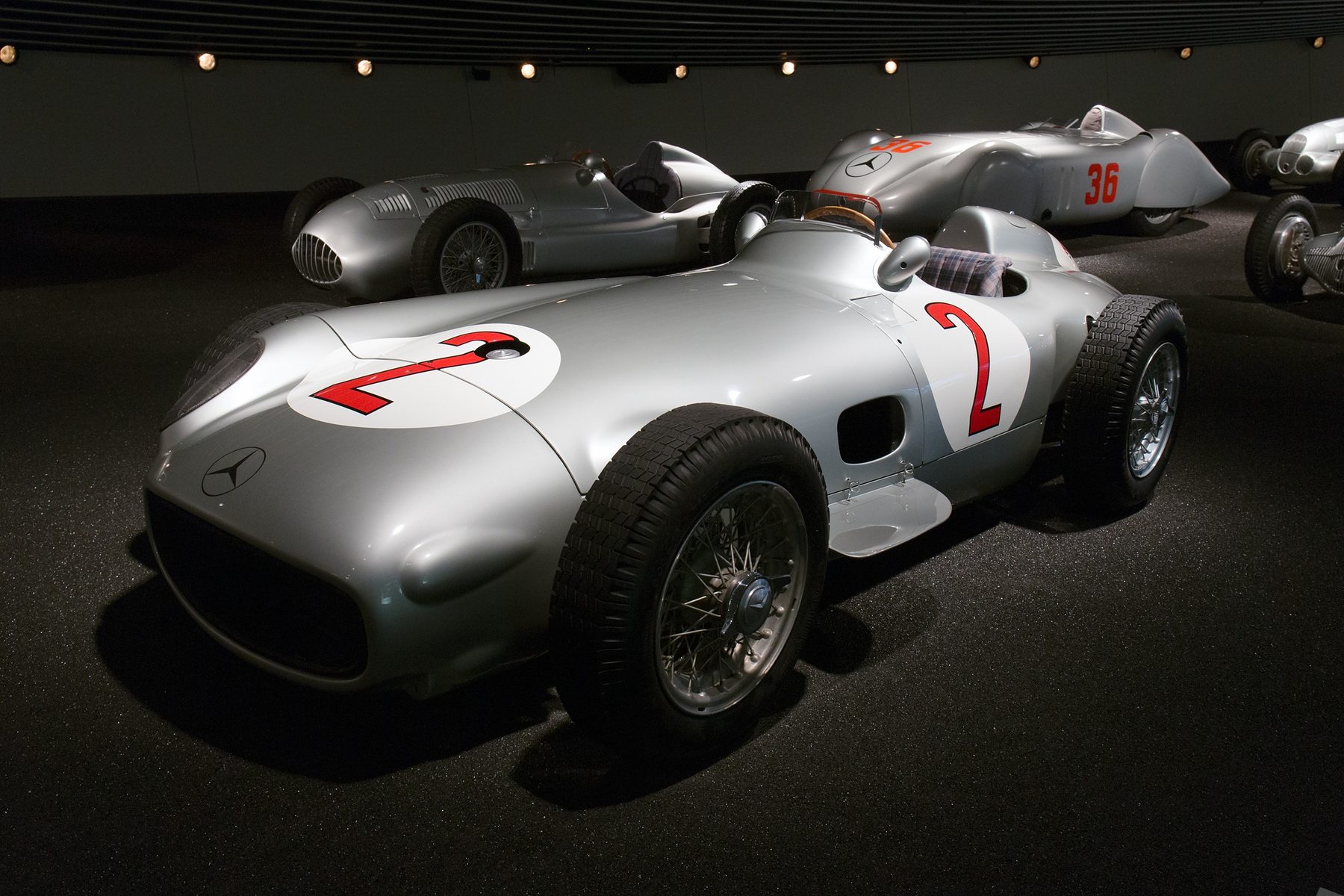
Mercedes-Benz W196
The factory called it the W 196 R. It came from Daimler-Benz’s engineering department, whose technical director was Fritz Nallinger; Rudolf Uhlenhaut ran the racing department, and Hans Scherenberg the design office; Ludwig Kraus drew the chassis and Hans Gassmann the engine. The engine was a straight-eight of about 2.5 litres, laid over at 60 degrees from the vertical, with Bosch direct fuel injection, desmodromic valves and a built-up roller-bearing crankshaft taking its drive from the middle. The frame was a space-frame of small tubes, the brakes were drums mounted inboard, and the swing axle at the back had a low pivot of Uhlenhaut’s design. It gave some 257 hp at first and about 290 by 1955.4 The streamlined body, of Elektron alloy, weighed about 40 kg.
It first raced at Reims in 1954 in that enveloping body, and won; it ran open-wheeled from the Nürburgring on, streamlined again at the fast circuits. At Silverstone the streamliner hid its front wheels from him and he dented it on the oil drums that marked the corners; after that race, Motor Sport said later, two open cars were built at his request. In the streamliner he won 3 of his 4 starts; in the open car, 5 of 8. The W196 won 9 of the 12 championship races it entered, 8 of them his, and he took 7 pole positions in it. In 1979 he summed it up in a line: “Not so nice to drive as a Maserati, but you were almost sure to finish.” The seasons are in 1954 and 1955.
Fourteen chassis were built, and ten were complete at the end of 1955, four of them streamliners. Mercedes-Benz still holds most of the survivors. Two have been sold at auction, and each set a record. Chassis 00006/54, his winner at the Nürburgring and Bremgarten in 1954, was lent to the National Motor Museum at Beaulieu in the 1970s, given to it and sold, and was sold again at Goodwood in 2013; chassis 00009/54, open-wheeled when it took him to victory in Buenos Aires in January 1955 in a race outside the championship, later wore the streamlined body for Moss at Monza, and was sold in Stuttgart in 2025. The sums are in Legacy.
Mercedes-Benz 300 SLR
The 300 SLR was the W196 made into a sports car, with two seats and a three-litre engine. He drove it alone in the Mille Miglia of 1955, with the passenger’s seat covered, and was second to Moss; he won the Eifelrennen at the Nürburgring and the Swedish Grand Prix at Kristianstad, and was second in the Tourist Trophy and the Targa Florio, and Mercedes-Benz took the sports-car championship. At Le Mans, where he shared No. 19 with Moss, the team withdrew its cars in the night after the disaster that killed more than 80 people. 1955 tells it.

X · The machines
Lancia and Ferrari
Lancia D24
Lancia’s sports car had a 60-degree V6, 245 to 265 hp by the museum’s figures, in a car of 740 kg. In November 1953 one carried him and Gino Bronzoni to victory across Mexico in the Carrera Panamericana, in the race that killed his team-mate Felice Bonetto; 1953 tells it. In 1954 he retired a D24 at Sebring and was second in another at Dundrod.
Lancia-Ferrari D50
Vittorio Jano designed the D50 for Lancia, with Ettore Zaccone Mina on the engine, a 90-degree V8 of about 2.5 litres with four camshafts. Jano made the engine part of the structure, carrying chassis loads, and angled it so that the propeller shaft ran beside the driver, and he slung the fuel in two pannier tanks between the wheels, so that the handling would change less as the fuel burned away. It first raced at Pedralbes in October 1954, with Ascari on pole. At Turin on 26 July 1955 six of Lancia’s eight D50s passed to Ferrari, together with spares, drawings, transport and a streamlined body that was nearly finished, and Fiat paid Ferrari some £30,000 a year to race them. Jano went with the cars.
As the Lancia-Ferrari D50, on Englebert tyres, it gave him his fourth title in 1956: 7 starts, 3 wins, 6 pole positions and 4 fastest laps. What he disliked was the year, not the car.5 For Enzo Ferrari that season he also won the Sebring 12 Hours in an 860 Monza, with Eugenio Castellotti, and took a 290 MM, chassis 0626, to fourth place in the Mille Miglia, which survives with its blue and yellow nose.
None of the D50s survives as it raced. The original cars were scrapped; the two in the museums of Turin were put together from parts. In 1999 six re-creations were being built round original V8s and transmissions found at Maranello, and the Revs Institute shows a car with a new chassis and body round an original engine, D50-0013.
X · The machines
A British car and the American roadsters
BRM V16
Raymond Mays’s British Grand Prix car, designed by Peter Berthon, had a supercharged V16 of 1.5 litres. Fangio drove it in six races in 1952 and 1953. At Albi and at Dundrod in 1952 it retired; at Albi in 1953 he won the Formula 1 heat with a lap record and retired from the final when shreds of tyre tread jammed its disc brakes; at Silverstone and at Goodwood later that year he was second. The 1952 page follows him from the BRM at Dundrod to the Maserati at Monza.
Kurtis Kraft and Kuzma
At Indianapolis in May 1958 he practised in George Walther’s car, the Dayton Steel Foundry Special, a four-cylinder Offenhauser in a Kurtis Kraft 500G chassis, passed his rookie test and went round at about 228 km/h (142 mph). He also drove a Kurtis Kraft 500F with a Novi engine. On 15 May he withdrew without trying to qualify. At Monza on 29 June, in the Race of Two Worlds, he drove the Dean Van Lines Special, a Kuzma-Offenhauser, and it retired. Both are in 1958.
X · The machines
The man and the machine
At Maserati the engineer and the chief mechanic each remembered him in his own way, and the engineer’s memory was of how little he took out of a car.
Fangio, you see, was always very soft, very gentle on the car. In a race he would consume 10-15 litres less fuel than the others, wear his brakes less, and all other parts of his car too. After he had gone we found the others in comparison were all very hard, rugged on the cars, and we had to make them stronger — but we wanted them lighter and more powerful as well.
Not every witness agreed. In 1953, when Fangio took over Bonetto’s Maserati at Bremgarten and its engine blew, Motor Sport preferred the other man’s touch, writing of “the swarthy Bonetto, who obviously does not take the stuffing out of a car like the Argentinian”. Bertocchi recalled which chassis he preferred, and how little he told the engineers: “Fangio liked the longer, more stable chassis and Behra the shorter, more nervous one. Fangio gave the engineers little information. He was not technical, he would drive very fast any car you gave him.” His Mercedes-Benz team-mates said the same of the setting-up, and Moss remembered that in the briefings Fangio would take Moss’s settings.
He was clear about what the car was worth. In 1989 he told Germán Sopeña how he had always answered the question: “75 per cent was the car and the team of people working around it, and the remaining 25 per cent the driver and luck.” His critics, especially in Italy, said he always manoeuvred himself into the best team, and Moss answered them in 1994: “The reason he had the best car was that he was the best damned driver!”

Statisticians have since tried to tell the driver’s share from the car’s, and the results are in Legacy. In 1961 a preface-letter printed in Severo Boschi’s book Tutto Fangio, presumed to be Enzo Ferrari’s though its signature is not visible in the copies seen, put it briefly:
Cosa posso aggiungere? Fangio è stato un grande, intelligente combattente. Egli ha sempre chiesto alla macchina tutto quello che essa poteva dare, niente di più.
What can I add? Fangio was a great, intelligent fighter. He always asked of the car everything it could give, nothing more.
Notes
His car at Monza in 1950 was a further-developed 158. F1DB and the museum call it a 158, ChicaneF1 and OldRacingCars the first 159; Alfa Romeo’s racing manager, Giovanni Battista Guidotti, told Doug Nye that the true 159 first raced at the 1951 German Grand Prix. Counted as a 158, it makes his record in that model 6 starts and 3 wins; counted as a 159, 5 starts and 3 wins, with 8 starts and 3 wins in the 159. ↑
The credit is shared out differently by each source. ChicaneF1 names Colombo as chief designer, with Bellentani as technical director; the museum names Alfieri as designer, Taddeucci and Nicola for the engine, Colotti for the chassis and Fantuzzi for the body. Alfieri, speaking to Doug Nye in 1981, dated his arrival to 1 August 1953. ↑
Denis Jenkinson’s chassis history holds that the real T3 Piccolos, chassis 2533 and 2534, came later in 1958, for Temple Buell’s team, so the identity of the Reims car is uncertain; see the note on the 1958 page. ↑
The figures differ by source. RM Sotheby’s gives 2,494 cc and 257 hp rising to about 290; the museum gives 2,496 cc and 290 hp at 8,700 rpm, or 298 hp, on the same page. Power figures of the period were quoted differently by every source. ↑
In 1979 he told Nigel Roebuck that the year with Ferrari was not a happy one: he never felt comfortable with the team, and he had no mechanic of his own until halfway through the season. F1DB’s season tables list a Ferrari 555 with a four-cylinder engine as Ferrari’s car of 1956, an error; every other source has him in the D50’s V8. ↑
Sources
F1DB, release v2026.15.1: results, grids, fastest laps and the chassis and engine tables. github.com
Jolpica F1 (Ergast lineage), database dump of 15 September 2026, for starts, wins and grids by constructor. api.jolpi.ca
ChicaneF1, car-model pages, among them the Alfa Romeo 158, and the driver profile. chicanef1.com
Museo Juan Manuel Fangio, Balcarce, the car pages (Alfa Romeo 158 and 159, W 196 R, Lancia-Ferrari D50, Maserati 250F and 250 V12, 4CLT/48, A6GCM, 300S and 450S, BRM V16, Ferrari 166 F2 and 860 Monza, Lancia D24, Mercedes-Benz 300 SLR and W 154/163, Talbot-Lago T26C, Alfa Romeo 6C 3000 CM, the Indianapolis cars). museofangio.com
FCA Heritage, “Alfa Romeo GP Tipo 159 ‘Alfetta’ at the British Grand Prix”, 2019. web.archive.org
Motor Sport: Doug Nye, “The incredible Maserati 250F”, July 2005 (his interviews of 1981 with Giulio Alfieri and Guerino Bertocchi); Paul Fearnley, “Ring leader”, December 2002; Nigel Roebuck, “The morning I met the maestro”, November 2010 (his interview of 2 June 1979); Doug Nye, “Lancia D50: the grand prix great that doomed a team”, July 2020; Andrew Frankel, “Lancia D50 re-creations nearing completion”, October 1999; “Fangio’s finest”, October 2007; “Fangio Mercedes for Goodwood sale”, May 2013; “Ferrari 290MM 0626”, December 2015; “Mercedes-Benz W196: Fangio’s $53m Silver Arrow”, 2025; the contemporary reports of September 1953 (“Grosser Preis der Schweiz”) and April 1951 (“Pre-war W163 Mercedes-Benz twice beaten by 2-litre Ferrari at Buenos Aires”); Denis Jenkinson on the 250F’s chassis histories, “The 250F Maserati”, April 1986, and “part three”, September 1986; Doug Nye, “The Alfetta tech that beat Ferrari”, December 2019, for Guidotti’s account; the obituary “Juan Manuel Fangio 1911–1995”, August 1995; Stirling Moss, “Fangio and Senna: Moss’s two greats”, November 1994, and Rob Widdows, “Stirling Moss: why I played willing understudy to Fangio”, November 2007; Nigel Roebuck, “Karl Kling: Legends”, May 2003. motorsportmagazine.com
Nigel Roebuck, interview with Fangio, Autosport, 21 June 1979, republished as “Fangio: interview with a legend”, 24 June 2011. autosport.com
RM Sotheby’s, lot r0001, “1954 Mercedes-Benz W 196 R Stromlinienwagen”, Stuttgart, 2025. rmsothebys.com
Revs Institute, “1955 Lancia D50”. revsinstitute.org
Germán Sopeña, interview with Fangio, La Nación Revista, February 1989, from the extract reprinted in La Nación, 23 March 2015. web.archive.org
Severo Boschi, Tutto Fangio (Calderini, Bologna, 1961), for the preface-letter. books.google.com
OldRacingCars, Italian Grand Prix, 1950. oldracingcars.com
Indianapolis Motor Speedway, “F1 rookies at IMS, part 1”, 10 April 2012. indianapolismotorspeedway.com
ESPN Deportes, “¿Por qué Juan Manuel Fangio no corrió las 500 Millas de Indianápolis?”, 25 May 2025. espndeportes.espn.com
Museo Juan Manuel Fangio, Fangio y el Turismo Carretera and Datos estadísticos de la campaña deportiva de Juan Manuel Fangio (PDF). museofangio.com