Part One · The life
V
The Nürburgring 4 August 1957
The 1957 German Grand Prix, lap by lap: a 52-second pit stop, a chase of Hawthorn and Collins, the lap record broken again and again, and a fifth world title.
a good race is where you don’t think you have a chance of winning

V · The Nürburgring
Friday, 2 August
In the first official practice for the German Grand Prix, on Friday 2 August 1957, Juan Manuel Fangio threw his Maserati 250F about on the bumps of the Nürburgring in long power slides. Watching him on the descent to Adenau, Denis Jenkinson of Motor Sport wrote that “one wondered if it wasn’t Fangio and not the Maserati that was handling well”. Almost at once Fangio lapped in 9:34, and then in 9:25.6. A year earlier, in a Lancia-Ferrari, he had left the lap record at 9:41.6; the circuit had since been partly resurfaced.
Vanwall had hired the track the day before, and found that its cars spent much of each lap in the air: mirrors fell off and bodies split. On Saturday nobody beat Fangio’s time. Mike Hawthorn came closest in a Lancia-Ferrari, with 9:28.4, then Jean Behra, in a second Maserati, with 9:30.5, and Peter Collins, in another Lancia-Ferrari, with 9:34.7. The four of them made the front row, Fangio on pole by 2.8 seconds. Tony Brooks, Harry Schell and Stirling Moss made up the second row. The Vanwalls of Moss, Brooks and Stuart Lewis-Evans were badly suited to the bumps.
The race was 22 laps of the Nordschleife’s 22.810 kilometres, 501.82 in all, for a field of 24 in which Formula 2 cars ran with the Grand Prix cars. Fangio, Behra and Schell each had one of the three lightweight 250Fs that Maserati had built for 1957. Fangio’s was No. 1, the car that Jenkinson later identified as chassis 2529. Hawthorn, Collins and Luigi Musso drove the 1957 Lancia-Ferraris. Motor Sport put the crowd at about 200,000; the museum at Balcarce says more than 100,000. The day was warm and dry.
V · The Nürburgring
Half a tank
Maserati raced on Pirelli tyres, softer and grippier than the Engleberts on the Ferraris, and the team knew they would not last 500 kilometres. The Ferraris could run the whole distance without a stop; the Maseratis could not. So Maserati made a plan of it. By the museum’s account, Fangio and Guerino Bertocchi, the chief mechanic, agreed that he would start on half-full tanks, pull out a lead of about 30 seconds, and come in around half distance for fuel and tyres, a stop that Bertocchi reckoned at about 30 seconds.
It could be seen. Motor Sport’s notes on the cars observed that the curve of the Maseratis’ rear leaf springs gave away their light loads, while the Lancia-Ferraris sat so heavy with fuel that their tails almost touched the ground. The fuel was a mixture of benzole, methanol and nitromethane, by Paul Fearnley’s account, and Giulio Alfieri, Maserati’s engineer, told Doug Nye in 1981 that the team had tested 43 or 44 mixtures.
V · The Nürburgring
Twelve laps in front
At a quarter past one Hawthorn and Collins went away side by side from the front row, and it was Hawthorn who led the first lap, in 9:42.5. Fangio followed them in third place. By his own account he spent 2 laps studying where he could attack, and on lap 2 Hawthorn set a new lap record of 9:37.9, only for Fangio to lower it at once to 9:34.6. At the start of lap 3 he went by Collins, and on the long descent to Adenau he went by Hawthorn, and he came round 5 seconds clear. As Jenkinson put it: “From then on there was only one man on the Nurburgring”.

He lowered the record again on lap after lap, gaining several seconds a lap. After 8 laps he was 28 seconds ahead, with a lap of 9:30.8; after 10, 9:29.5. At the end of lap 10 Behra came in for tyres and fuel, the first of Maserati’s planned stops, and at the end of lap 11 the pit showed Fangio the signal to come in next time round.
V · The Nürburgring
Fifty-two seconds
- Seconds in hand
- 28
- Seconds stopped
- 52

At the end of lap 12 he pulled into the pit with his 28 seconds in hand, 29 by his own reckoning, and climbed out of the car. Motor Sport wrote that “two mechanics took 52sec to change rear wheels and refuel, a disgustingly long time by Grand Prix standards”. As the worn right rear wheel came off, Paul Fearnley wrote in 2017, its hub nut went with it and rolled away under the car, while Fangio, out of the cockpit, took a drink. Schell’s routine stop took 52 seconds too. The two Ferraris went past while Fangio stood in the pit.
He rejoined third, more than three-quarters of a minute behind them, and in 1989 he could still do the sum: “when I came out to start again I’d lost 30s plus another 48s!” He left the pits, he said, very disappointed, and sure that he had lost the race. That is why the story that the slow stop was a trick to lull Ferrari into easing off, which Fearnley dismisses as public relations, does not stand. There was an irony in it, too: 24 years later Bertocchi told Nye that Maserati’s mechanics had once changed a wheel in 12 seconds at Naples, with hammers, not air guns.
V · The Nürburgring
The chase
Laps 13, 14 and 15 brought him no nearer, on new tyres and a full load of fuel. On lap 13 Collins broke the record with 9:28.9, and by the museum’s figure Fangio was 51 seconds behind at the end of that lap. The Ferrari drivers took turns to lead, and as they passed the pits each of them steered with one hand and shaded his eyes from the lowering sun with the other. Hawthorn admitted later that they had eased off too soon. Pit signals, Nigel Roebuck pointed out, could reach them only once a lap, about every 10 minutes, and in one lap Fangio could do a great deal.

Lap 16 was the turn, and from there the gap shrank by several seconds a lap. He was taking the fast corners in the gear above the usual one, which made the Maserati feel unsettled, Fearnley wrote, but gained him tenths of a second. At one jump before a bridge he kept his foot to the floor, he said, took off from the inside kerb and landed at the very edge of the road: “Behind me I saw a cloud of dust on the verge. I had just made it. … And I liked it, too.” (attributed)
After lap 16 the gap was 33 seconds. After lap 17, in which he broke Collins’s record with 9:28.5, it was 25.5. On lap 18 he went round in 9:25.3, under his own pole time, and on lap 19 in 9:23.4, and the gap was 13.5 seconds. The Ferrari pit was frantic, but Jenkinson knew what it meant: “when ‘the old man’ gets in a record-breaking groove there is no one to stop him, especially on the Nurburgring.”
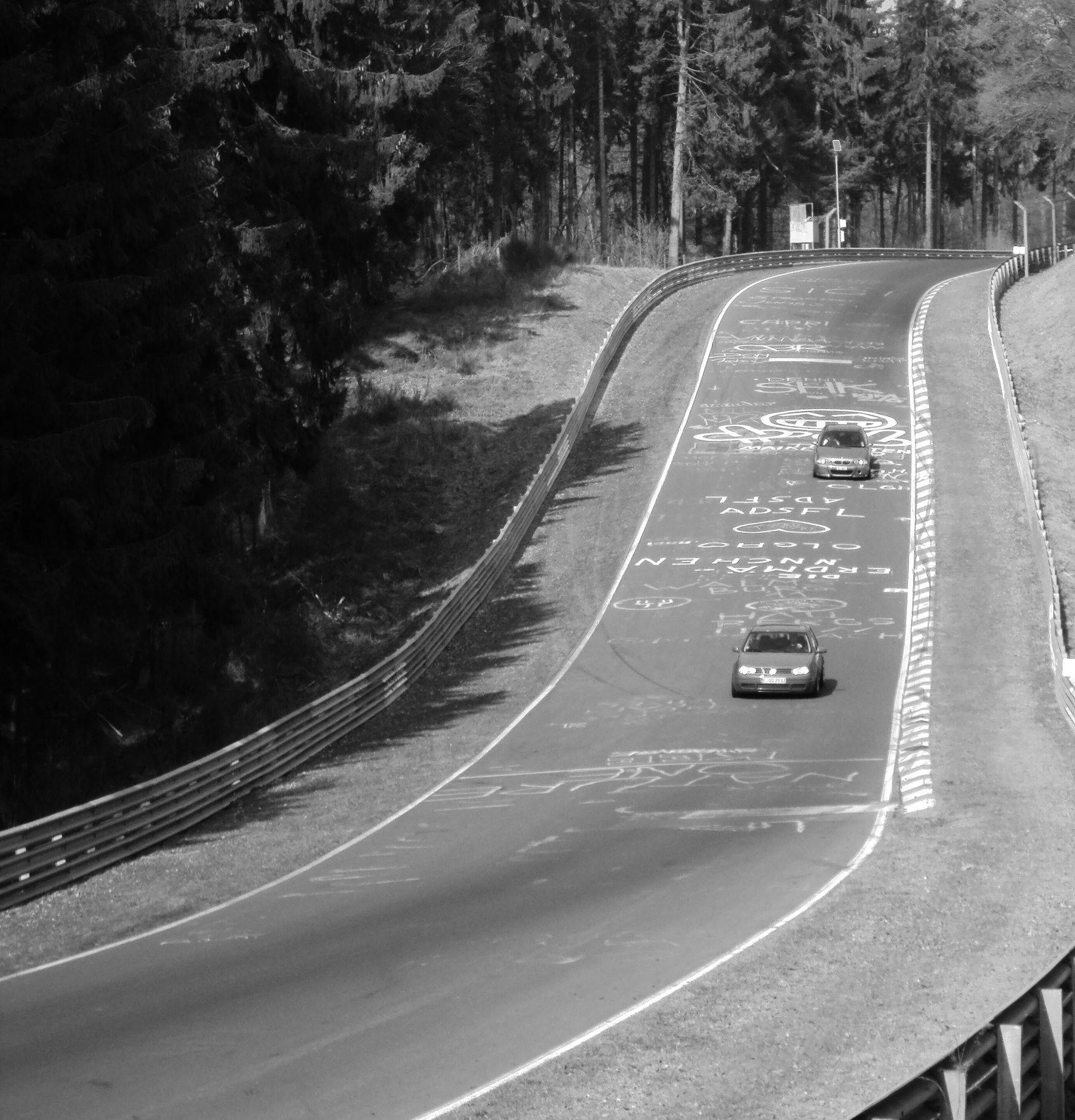
Then, on lap 20, the loudspeakers announced it: “Fangio has just lapped in 9min 17.4 sec!” It was 8.2 seconds under his pole time and 24.2 seconds under the record he had set the year before, an average of 147.3 km/h (91.53 mph), and Motor Sport reckoned that he had taken 11 seconds out of Hawthorn in 14 miles. At the end of the lap he was 2 seconds behind.1
V · The Nürburgring
I had to risk
This race was almost lost for me. So I had to risk. … That’s something I never did before in my life.
- His lap 20, a new record
- 9:17.4
V · The Nürburgring
Lap 21
The crowd rose as the three cars came past the pits to begin the penultimate lap. Round the Südkurve Jenkinson saw that “he was grinning contentedly at the two young boys”, and as Collins turned into the Nordkurve, the left-hander behind the pits, Fangio went through on the inside. By his own account the Maserati ran wide and Collins came back past, and the two of them ran together to a short straight with a bridge: “At the speed we were going, it seemed that there wouldn’t be room for two cars. Collins gave way.” (attributed) Hawthorn remembered Fangio going by his team-mate with two wheels on the grass, spraying the Ferrari with earth and stones. A stone broke one of the lenses of Collins’s goggles, and his clutch was failing.
Fangio pulled the same trick, cut sharply inside and forced me out onto the grass and almost into the ditch. He looked round almost apologetic.
Hawthorn was the next. Fangio caught him on a straight that ended in a 90-degree left-hander, with a right-hander after it, and put the nose of the Maserati inside. Before the course reached its lowest point, at Breidscheid, he was in the lead.
Hawthorn did not give up. He was only 3 seconds behind as Fangio began the last lap, and he went round in 9:24, losing no more than a few yards. It was not enough.

He won by 3.6 seconds, in 3 hours 30 minutes 38.3 seconds.2 Collins was third, 35.6 seconds behind, and Musso fourth, more than three and a half minutes down. Moss was fifth, so worn out that he could hardly climb out of the Vanwall, and Behra sixth, a second behind him; Brooks had been sick in his car on the last lap. Fangio’s 22 laps, stop and all, averaged 9:34.5, faster than the lap record he had set the year before.
V · The Nürburgring
Lap by lap
| Lap | What happened | Time | Pl. |
|---|---|---|---|
| 1 | Hawthorn and Collins lead away side by side; Hawthorn’s standing lap is 9:42.5 | — | 3 |
| 2 | A lap record, just after Hawthorn’s 9:37.9 | 9:34.6 | 3 |
| 3 | Past Collins at the start of the lap and Hawthorn on the descent to Adenau; 5 s clear at the line (time from the museum) | 9:33.4 | 1 |
| 4 | A record lap; time not given | — | 1 |
| 5 | A record lap; time not given | — | 1 |
| 6 | Time from the museum | 9:32.5 | 1 |
| 7 | No time given | — | 1 |
| 8 | A lap record; 28 s ahead | 9:30.8 | 1 |
| 9 | No time given | — | 1 |
| 10 | A lap record; Behra makes Maserati’s first planned stop | 9:29.5 | 1 |
| 11 | Signalled to come in next time round | — | 1 |
| 12 | Stops at the end of the lap, 28 s ahead; 52 s at a standstill; rejoins third | — | 1 |
| 13 | New tyres, a full tank; Collins sets a record of 9:28.9; 51 s behind (museum) | — | 3 |
| 14 | No impression on the Ferraris | — | 3 |
| 15 | No impression on the Ferraris | — | 3 |
| 16 | 33 s behind | — | 3 |
| 17 | A lap record; 25.5 s behind | 9:28.5 | 3 |
| 18 | A lap record, under his pole time; 21 s behind (museum) | 9:25.3 | 3 |
| 19 | A lap record; 13.5 s behind | 9:23.4 | 3 |
| 20 | A lap record; 2 s behind Hawthorn at the line | 9:17.4 | 3 |
| 21 | Past Collins at the Nordkurve and Hawthorn before Breidscheid | — | 1 |
| 22 | Hawthorn laps in 9:24 and finishes 3.6 s behind | — | 1 |
Time: his lap, a dash where no source gives one. Place: at the end of the lap. From Motor Sport’s report of September 1957 unless the museum is named; the winning margin is F1DB’s, and the sources give no complete count of his record laps.
V · The Nürburgring
As if they had won
He told what came after the finish himself:
En los boxes recibí una interminable ovación y el público me paseó en andas. Pero lo más hermoso fue el encuentro con Collins y Hawthorn, que me esperaban en el podio para estrecharse conmigo, como si hubieran ganado ellos.
In the pits I got an endless ovation and the crowd carried me shoulder-high. But the loveliest thing was meeting Collins and Hawthorn, who were waiting for me on the podium to embrace me as if they had won.


Andrea Berruet had been his companion since the mid-1930s. In some of the podium pictures, Fearnley wrote, the man famous for his stamina looks, suddenly, every one of his 46 years. The car had paid too. Both of its front suspension pivots were found seized, clogged with earth and grass, and the seat had worked loose, so that on the last laps he braced a knee against the side of the cockpit. He remembered that part of it: “But I had a problem; one of the screws in the back of my seat broke on the last lap.”
It was the last of his 24 World Championship wins. He left the circuit on 34 counted points, Musso on 16 and Hawthorn on 13, with two rounds to run: the title was his for the fifth time. In November the Nürburgring named him its Ring-Meister, for a third German Grand Prix win there in succession. The circuit meant more than that to him. In 1954 his young protégé Onofre Marimón had been killed there in practice. “So this circuit had given me happiness and sadness.”
V · The Nürburgring
Even now
For two nights, by Fearnley’s account, the small miscalculations of that afternoon kept him awake. In June 1979, 22 years later, Nigel Roebuck asked him about the race at the Steering Wheel Club in London, and he answered through an interpreter:
Even now I can feel fear when I think of that race. I knew what I had done, the chances I had taken. The Nurburgring was always my favourite circuit without any doubt. I loved it, all of it, and that day I think I conquered it. On another day it might have conquered me, who knows? But I believe that day that I took myself and my car to the limit and perhaps a little bit more. I had never driven like that before, and I knew I never would again.
The words most often put in his mouth, that he had never driven so quickly in his life, have no known source; these are the ones he was recorded saying.3 In 1977, for the circuit’s 50th anniversary, and again in 1986, he went back to drive a Mercedes-Benz W196 there for the crowds, as the chapter After racing tells. He never raced at the Nürburgring again.

Notes
The gaps are Motor Sport’s of September 1957. The museum’s account differs in details: it has him 3 seconds behind Hawthorn after lap 20, and gives 9:25.5 for lap 10 and 9:28.9, which was Collins’s record, for lap 17. How far behind he rejoined after the stop is more than three-quarters of a minute in Motor Sport, 48 seconds by Fangio’s own account, almost 50 seconds in Fearnley’s and close to a minute in Roebuck’s. No source counts his record laps in full. ↑
The margin is 3.6 seconds in F1DB and in the museum’s account; Motor Sport made it barely 4 seconds. ↑
The familiar version appears without a source; it is discussed with the doubtful quotations in the chapter of his words. The words above are those printed in Autosport on 21 June 1979; Roebuck’s retelling in Motor Sport in 2010 keeps the same key sentence. ↑
Sources
Denis Jenkinson, “Fangio the supreme master” and “XIX Grosser Preis von Deutschland” (with the notes on the cars), Motor Sport, September 1957. motorsportmagazine.com
F1DB, release v2026.15.1: qualifying times, grid, result, race time, gaps, fastest lap and standings. github.com
“German GP, 1957”. grandprix.com
Museo Juan Manuel Fangio, “1957”, the championship page with Fangio’s own account of the race. museofangio.com
Paul Fearnley, “The greatest lap”, Motor Sport, June 2017; “Ring leader”, Motor Sport, December 2002; “Mike Hawthorn: Britain’s forgotten world champion”, Motor Sport, February 2019. motorsportmagazine.com
Nigel Roebuck, interview with Juan Manuel Fangio, Autosport, 21 June 1979, republished as “Fangio: interview with a legend”, 2011; “1957 German GP: Fangio’s day of days at Nürburgring”, Motor Sport online; “The morning I met the maestro”, Motor Sport, November 2010. autosport.com, motorsportmagazine.com
Adam Cooper, “Race of my life: Juan Manuel Fangio on the 1957 German GP”, Autosport, December 1989. autosport.com
Doug Nye, “Buone, forte, veloce”, Motor Sport, July 2005: Alfieri and Bertocchi in 1981; Denis Jenkinson, “The 250F Maserati – Part one”, Motor Sport, April 1986. motorsportmagazine.com