Reference
Records 24 wins, 29 poles, and the records that still stand
Juan Manuel Fangio in numbers: 51 World Championship starts, 24 wins and 29 poles, the records that still stand, those that fell, and every win and pole.
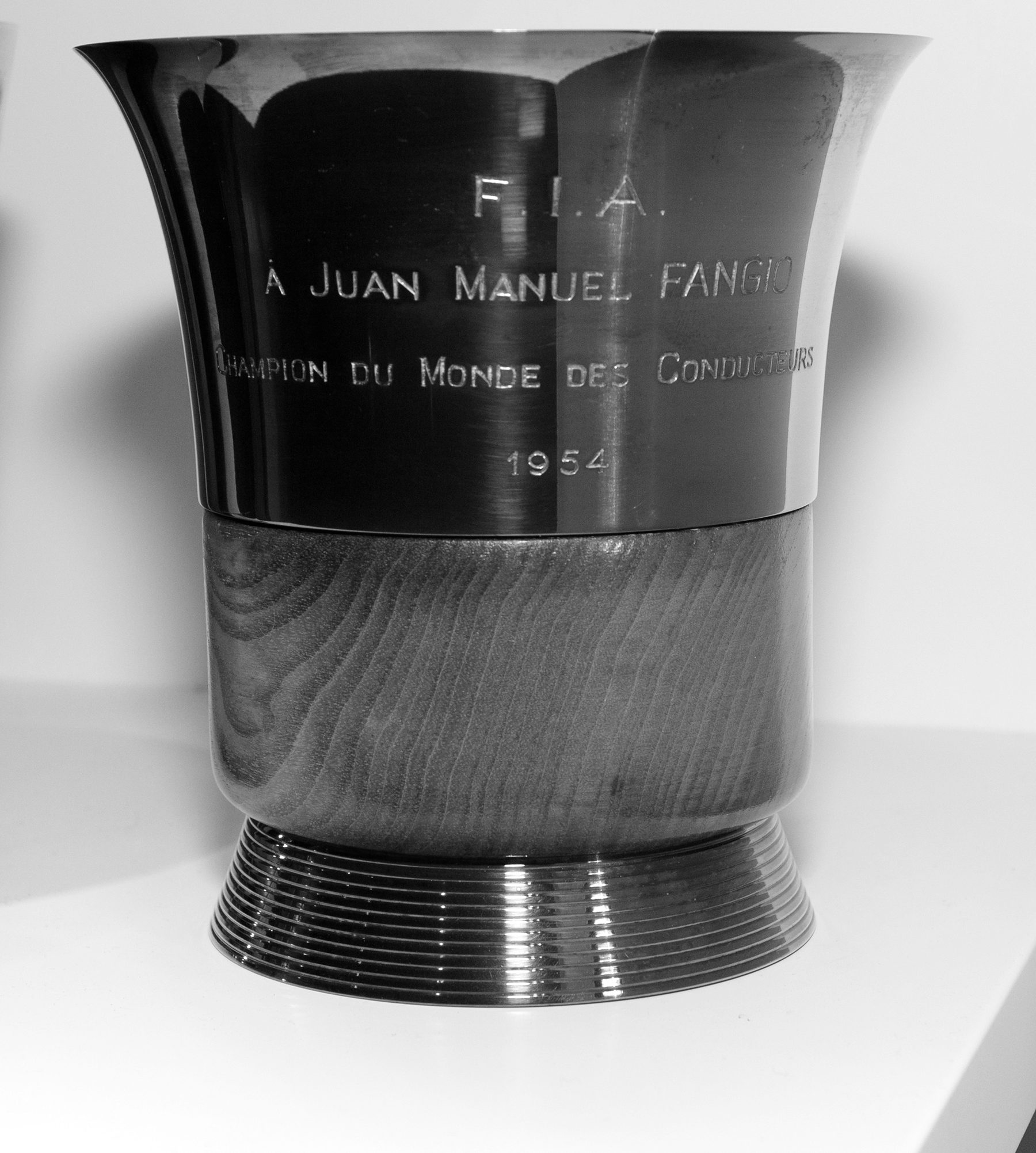
Records
In London in June 1979, more than 20 years after his last race for Mercedes-Benz, Fangio gave Nigel Roebuck his record with the team from memory:
I drove 12 Grands Prix for Mercedes, with eight wins, one second, one third, one fourth – and one retirement. In those days, you know, F1 cars were not so reliable, so the Mercedes was incredible in that way.
Both of the databases this page is built on agree with him to the last place. They are F1DB and Jolpica, the successor to Ergast; the figures here were computed from each of them separately, and they agree on his starts, wins, poles, podiums, titles and ages. Where one of them has no data, as Jolpica has none on fastest laps before 2004, the source used instead is named.
- World Championships
- 5
- Grand Prix wins
- 24
- Pole positions
- 29
- Grands Prix started
- 51
Records
Fifty-one starts
His World Championship ran from his debut at Silverstone in May 1950 to his last race at Reims-Gueux in July 1958, nine seasons in which he raced in eight. He started 51 races and won 24; in two of those wins, the French Grand Prix of 1951 and the Argentine of 1956, the car was a team-mate’s. He took 29 pole positions, set 23 fastest laps, one of them the lap shared by seven drivers at Silverstone in 1954, and finished 35 times on the podium and 43 times in the points. Twice he took pole, won, set the fastest lap and led every lap: at Monaco in 1950 and at the Nürburgring in 1956. His points total is 244½, often given as 245.1
He was seldom far from the front of the grid. He started from the first two places 42 times: 29 from pole and 13 from second. He started third four times and fourth four times, and only once further back, eighth, in his last race. Divided by his starts, he won 47.06 per cent of his races, took pole in 56.86 per cent, set the fastest lap in 45.10 and finished on the podium in 68.63; counting his entry for the 1958 Indianapolis 500, withdrawn before qualifying, as a 52nd race brings the first two down to 46.15 and 55.77.
By make, Mercedes-Benz gave him the best rate, 8 wins from 12 starts, and The machines gives the others. By season, his best was 1954, with 6 wins from 8 starts, and he won at least once in every season but his last, when he started twice. He was champion in five of the eight seasons he raced, and never lower than second in a season he raced in full.
Records
The wins
Every World Championship race he won, with the car and his place on the grid. The two in a team-mate’s car say whose.
| No. | Grand Prix | Grid |
|---|---|---|
| 1 | Monaco Grand Prix | 1 |
| 2 | Belgian Grand Prix | 2 |
| 3 | French Grand Prix | 1 |
| 4 | Swiss Grand Prix | 1 |
| 5 | French Grand Prix | 1 |
| 6 | Spanish Grand Prix | 2 |
| 7 | Italian Grand Prix | 2 |
| 8 | Argentine Grand Prix | 3 |
| 9 | Belgian Grand Prix | 1 |
| 10 | French Grand Prix | 1 |
| 11 | German Grand Prix | 1 |
| 12 | Swiss Grand Prix | 2 |
| 13 | Italian Grand Prix | 1 |
| 14 | Argentine Grand Prix | 3 |
| 15 | Belgian Grand Prix | 2 |
| 16 | Dutch Grand Prix | 1 |
| 17 | Italian Grand Prix | 1 |
| 18 | Argentine Grand Prix | 1 |
| 19 | British Grand Prix | 2 |
| 20 | German Grand Prix | 1 |
| 21 | Argentine Grand Prix | 2 |
| 22 | Monaco Grand Prix | 1 |
| 23 | French Grand Prix | 1 |
| 24 | German Grand Prix | 1 |
Bold grid figure: from pole position.
Records
The poles
Every pole position, with the result; the rule marks the poles he turned into wins.
| No. | Grand Prix | Res. |
|---|---|---|
| 1 | Monaco Grand Prix | 1 |
| 2 | Swiss Grand Prix | Ret |
| 3 | French Grand Prix | 1 |
| 4 | Italian Grand Prix | Ret |
| 5 | Swiss Grand Prix | 1 |
| 6 | Belgian Grand Prix | 9 |
| 7 | French Grand Prix | 1 |
| 8 | Italian Grand Prix | Ret |
| 9 | Belgian Grand Prix | Ret |
| 10 | Swiss Grand Prix | 4 |
| 11 | Belgian Grand Prix | 1 |
| 12 | French Grand Prix | 1 |
| 13 | British Grand Prix | 4 |
| 14 | German Grand Prix | 1 |
| 15 | Italian Grand Prix | 1 |
| 16 | Monaco Grand Prix | Ret |
| 17 | Dutch Grand Prix | 1 |
| 18 | Italian Grand Prix | 1 |
| 19 | Argentine Grand Prix | 1 |
| 20 | Monaco Grand Prix | 2 |
| 21 | Belgian Grand Prix | Ret |
| 22 | French Grand Prix | 4 |
| 23 | German Grand Prix | 1 |
| 24 | Italian Grand Prix | 2 |
| 25 | Monaco Grand Prix | 1 |
| 26 | French Grand Prix | 1 |
| 27 | German Grand Prix | 1 |
| 28 | Pescara Grand Prix | 2 |
| 29 | Argentine Grand Prix | 4 |
Azure rule: won from pole.
Records
Taken and passed
He became the record holder for poles at Bremgarten in June 1950, for wins at Reims two races later, and for fastest laps in 1951. Alberto Ascari went past him in wins and poles in 1952 and 1953, and he took both records back, poles at the Nürburgring in August 1954 and wins in Buenos Aires in January 1955. When he stopped, in July 1958, he held the records for wins, pole positions, fastest laps, podiums, titles and finishes in the points, and, by ChicaneF1’s count, for second places, 10 of them, for races led and for laps led, 1,348.
Jim Clark took three of them in one season and a New Year’s Day. He equalled the 23 fastest laps at Monaco on 7 May 1967 and passed them at Zandvoort on 4 June; he equalled the 29 poles in the German Grand Prix on 6 August and passed them at Mosport on 27 August; and after equalling the 24 wins in Mexico on 22 October, he won his 25th Grand Prix at Kyalami on 1 January 1968. Graham Hill passed the 35 podiums at Monaco on 18 May 1969. Of the records dated here, the titles lasted longest: he held the record alone from Aintree in July 1955, and five titles stood alone until Michael Schumacher equalled them in July 2002 and passed them in October 2003, as Legacy tells.
Some records are claimed for him that are not his. He is not the oldest winner of a Grand Prix: Luigi Fagioli was 53 years and 22 days old on the day they shared the French Grand Prix of 1951, and Nino Farina was 46 years and 276 days old when he won in 1953. Nor is he the oldest driver on pole: Farina again, at 47 years and 79 days, in Argentina in 1954. He won with four makes, as Jackie Stewart and Alain Prost did; Stirling Moss won with five. And his four titles in a row, 1954 to 1957, were the record only until Schumacher won five, from 2000 to 2004.
Records
What still stands
As at 30 September 2026. Every rate but the pole rate is a record only above a stated number of starts, and each says which; ChicaneF1, which sets none, lists no record of his as standing.
- Age, in years, of the oldest World Champion
- 46
- 46 years and 41 days, on the day he clinched the 1957 title at the Nürburgring. He also holds second, third and fifth places; the oldest champion besides him is Farina, 43 years and 308 days, in 1950.
- Poles from 51 starts: the highest rate of all
- 29
- 56.86 per cent. The next is Jim Clark’s, 33 from 72.
- Wins from 51 starts
- 24
- 47.06 per cent, the highest of any driver with more than two starts; Lee Wallard won one of his two Indianapolis 500s. Next comes Ascari, 13 from 32.
- Podiums from 51 starts
- 35
- 68.63 per cent, the highest of any driver with 10 starts or more.
- Fastest laps from 51 starts
- 23
- 45.10 per cent, the highest with 10 starts or more, by F1DB’s count.
- Makes he won the title with
- 4
- Alfa Romeo, Maserati, Mercedes-Benz and Ferrari. No one else has won it with more than two.
- Makes in a single title season
- 2
- Maserati and Mercedes-Benz in 1954: no other champion has driven for two makes in the year of his title.
- Titles from eight seasons raced
- 5
- 62.5 per cent. Schumacher won 7 of 19 and Lewis Hamilton 7 of 20.
Records
Among the others
Set beside the men he raced, the rates stand out further. Ascari, champion in 1952 and 1953, won 13 of his 32 starts; Moss won 16 of 66 and was never champion; Farina, the first champion, won 5 of 33. In the races they started together he finished ahead of Moss 21 times in 32 and of Ascari 15 times in 25, and Rivals and friends gives the rest. Of the drivers who came after him, Jim Clark came nearest: 25 wins and 33 poles from 72 starts. Points are not compared across the eras here: a win was worth 8 points in his day and only the best results counted, while now it is worth 25 and every result counts.
The last of his records came in his last season. At the Argentine Grand Prix of January 1958, his last start but one, he took pole and set the fastest lap at 46 years and 209 days old, and in the 68 years since, by F1DB’s count, no driver has set a fastest lap at a greater age.
Notes
The official record, formula1.com’s, shares between him and Ascari the point for the fastest lap they set together at Reims in 1953, and Motor Sport’s arithmetic of May 1954 does the same, which gives 244½. F1DB, Jolpica and most books credit him with the whole point, which makes 245. The points he scored before the best-results rule discarded some were 277 1/7 by the official figures, or 277 9/14 in F1DB. ↑
Sources
F1DB, release v2026.15.1, 27 September 2026, the open Formula One database: totals, rates, grids, ages, decider races and record dates. github.com
Jolpica F1, the successor to the Ergast database, dump of 15 September 2026, for the same figures, computed separately. api.jolpi.ca
Formula One, results archive: Juan Manuel Fangio, 1950–1958, for the official points. formula1.com
ChicaneF1, driver profiles of Juan Manuel Fangio, Jim Clark and Graham Hill: fastest laps, races and laps led, second places, and the dates the records fell. chicanef1.com
“The world’s leading Grand Prix drivers”, Motor Sport, May 1954. motorsportmagazine.com
Nigel Roebuck, “The morning I met the maestro”, Motor Sport, November 2010, from his interview with Fangio of 2 June 1979. motorsportmagazine.com